
Is There a Good SuperKilometerFilter Alternative?
Last Updated: October 28, 2026
Quick Summary
A mileage blocker is a device that holds the odometer reading steady while a vehicle is driven, which racing teams use for dyno runs, diagnostics and private circuit laps where mileage has no useful meaning. Choosing one means checking which control units it covers, how it handles bus signals and firmware updates, and whether it fits your model. Its legal use depends on purpose, since misrepresenting mileage on a sale can be an offence.
- Confirm the module covers every control unit your tuning or diagnostic work touches.
- Ask whether the supplier filters frames or substitutes fixed values, since each behaves differently.
- Check firmware update behaviour, as a module that is not update-aware can cause fault codes.
- Record the odometer before and after each session and keep your own log of the drive.
- Confirm vehicle compatibility before buying, especially for electric vehicles not on the model list.
Table of Contents
- What a Mileage Blocker Does and Where Racing Teams Use One
- How Mileage Stoppers Work Across the Control Units
- Using a Mileage Blocker for Track Days
- Using a Mileage Blocker for Dyno Testing
- Checking Mileage Blocker Vehicle Compatibility Before You Buy
- Plug-and-Play Mileage Blocker Installation and Support
- Legal Compliance, Warranty and Choosing Your Next Step
- Frequently Asked Questions
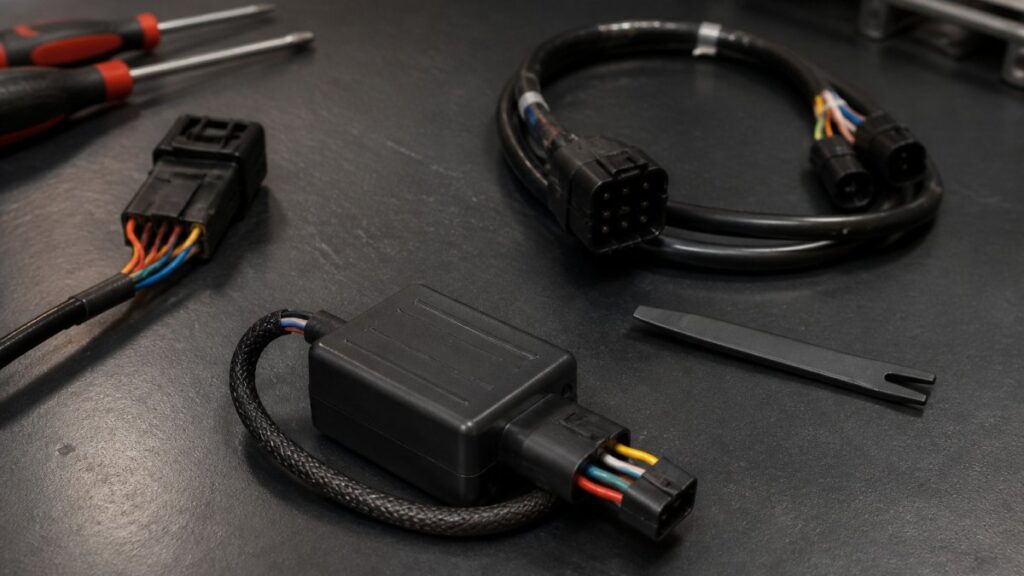
Racing teams, tuners and track-day drivers keep looking for a SuperKilometerFilter alternative because the job is narrow: stop mileage from building up during testing, without the device becoming a problem. Mileage Blocker makes UK-made mileage blocker modules for dyno testing, diagnostics, track days and off-road use, and this guide explains how the category works so you can judge any option, ours included. The research available for this piece is thin, so we have kept claims to what can be verified and flagged everything else.
What a Mileage Blocker Does and Where Racing Teams Use One
A mileage blocker is a device that holds the odometer reading steady while a vehicle is driven. Teams use it where mileage is not the point of the drive: power runs on a dyno, diagnostic sessions, and laps on a private circuit where the odometer would otherwise climb with no useful meaning. Such specialized applications remain distinct from the standard practice of checking vehicle mileage when evaluating the history of a pre-owned motorcycle.
The same device raises legitimate concerns. Critics compare odometer blocking to rolling back an odometer, and the honest answer is that legality depends on use.
How Mileage Stoppers Work Across the Control Units
- Bus coverage. Some modules handle a single CAN channel; others cover multiple channels (for example powertrain CAN and comfort CAN) or newer architectures such as CAN FD and automotive Ethernet. A module that covers only one channel can leave a trace on another.
- Signal handling. Filtering (blocking the frame) and substitution (replacing the payload with a fixed value) behave differently during diagnostic readouts and firmware updates. Ask which method a supplier uses.
- ECU coverage. Which modules the device actually reaches, cluster only, or cluster plus engine, transmission and ABS, determines whether the mileage history stays consistent across the vehicle.
- Firmware behaviour. Vehicles receive over-the-air and dealer firmware updates; a module that is not update-aware can be exposed or can cause fault codes after an update.
Using a Mileage Blocker for Track Days
The practical checks before a session are straightforward: confirm the module is fitted correctly, record the odometer reading before you leave, and check it again afterwards. Read our full guide to preventing mileage accumulation on track days for more detail on each step. Keep your own log of the session, because the device is there to hold a reading, not to explain it later.

Using a Mileage Blocker for Dyno Testing
Tuners tend to run several sessions a week on the same car, so the fitting only has to be done once per vehicle. The question to settle first is whether the module covers the control units your tuning work touches, because a partial solution can leave a trace in exactly the place you were trying to avoid.
The table below summarises the key checks tuners should make before fitting a module.
| Check | Why it matters | Action |
|---|---|---|
| Control unit coverage | A partial solution can leave a trace | Confirm the module reaches the units your tuning touches |
| Fitting frequency | Tuners run several sessions a week | Fit once per vehicle |
| Coverage scope | Determines mileage consistency across the car | Check cluster, engine, transmission and ABS |
Checking Mileage Blocker Vehicle Compatibility Before You Buy
For electric vehicles, check the model list specifically. Our EV range covers more than 70 electric vehicles, including VW ID models, Kia EV6, Hyundai Ioniq 5, BYD, Polestar and Audi e-tron, but a model not on the list should be confirmed with the supplier before purchase. Browse the full electric vehicle range to see whether your model is covered. Owners of older classic cars should also ask directly, since older electronics behave differently from current architectures.
Plug-and-Play Mileage Blocker Installation and Support
Our modules are plug-and-play and come with fitting guides and 24/7 expert support. See what round-the-clock support covers before you buy.
Legal Compliance, Warranty and Choosing Your Next Step
- Consumer protection and fair trading. Under the Consumer Protection from Unfair Trading Regulations 2008, misleading a consumer about a vehicle’s history, including its mileage, is a banned commercial practice (The Consumer Protection from Unfair Trading Regulations 2008). A private seller or trader who misrepresents mileage can face enforcement action and civil liability.
- Fraud. The Fraud Act 2006 covers dishonesty, including false representation about a vehicle’s mileage where there is an intent to make a gain or cause a loss. Odometer tampering with a view to sale is the classic example.
- Road traffic and construction-and-use rules. Vehicles used on public roads must comply with construction-and-use requirements, and altering recorded mileage on a road-going vehicle can engage those provisions as well as insurance obligations. Insurers expect accurate mileage disclosure; non-disclosure can affect cover.
- Recorded-mileage checks. Services such as the DVLA’s vehicle enquiry and the MOT history service, plus commercial history checks, retain mileage data points (How we’ve opened up our MOT history data). A vehicle whose recorded mileage is inconsistent across those sources is a red flag to any buyer or trader.
Our modules carry a 12-month warranty. Pricing depends on quantity, dates and delivery; please contact us for current prices or a quote.
Frequently Asked Questions
What are the alternatives to SuperKilometerFilter for racing enthusiasts?
Mileage Blocker provides mileage blocker modules for dyno testing, diagnostics, track days and off-road use. Its modules are UK-made, plug-and-play, backed by a 12-month warranty and supported 24/7. Contact Mileage Blocker for current prices or a quote.
Are mileage blockers compatible with every vehicle?
No single module suits every vehicle, so compatibility depends on the make, model and year of the car and the control units it uses. Before buying, confirm with the supplier which vehicles the module supports, and check whether a vehicle-specific version is required. Ask whether the module works on the specific model you own rather than relying on a general claim.
How difficult is it to install a plug-and-play mileage blocker?
Mileage Blocker modules are plug-and-play and come with fitting guides.
How can I use a mileage blocker without misrepresenting a vehicle’s mileage?
Mileage blockers are intended for testing, dyno work and off-road use on private land, not for altering the mileage shown on a vehicle offered for sale or on public roads. Keep records of your testing purpose and make sure any mileage displayed is not presented to a buyer or authority as genuine. Seek independent legal advice if you are unsure how the rules apply to your situation.

Leave a Reply