

Table of Contents
- Why Detecting Digital Odometer Traces Matters
- Step 1: Check Your Vehicle Mileage History
- Step 2: Inspect Physical Wear and Tear Against Mileage Claims
- Step 3: Perform a Car Diagnostic Scan for Mileage Data
- Step 4: Identify Digital Odometer Rollback Signs
- Step 5: Spot Mileage Discrepancies Between Records
- Step 6: Gather and Document Your Evidence
- Limitations of Digital Odometer Detection Methods
- Frequently Asked Questions
Last Updated: October 12, 2026
Why Detecting Digital Odometer Traces Matters
Odometer tampering is a serious concern when buying a used vehicle: a rolled-back odometer can hide thousands of miles of wear and tear.
The ability to detect digital odometer traces matters more than ever as modern vehicles rely on electronic systems rather than mechanical gauges.
At Mileage Blocker, we understand that verification is critical for anyone buying a used vehicle or conducting pre-purchase inspections.
Step 1: Check Your Vehicle Mileage History
Gather all available mileage records to build a timeline that reveals inconsistencies or suspicious jumps.
Start by collecting these documents:
- Service and maintenance records from dealerships and independent mechanics
- MOT (Ministry of Transport) test certificates, which record mileage at each inspection
- Insurance documents, which often note mileage at policy renewal
Plot the mileage on a timeline: a legitimate vehicle shows consistent progression, while a drop, long plateau, or dramatic jump is a red flag.
MOT certificates are your best free resource. The DVLA maintains these records, and they show exact mileage at each annual test (Check the MOT history of a vehicle). Request the vehicle’s full MOT history, it’s public information and reveals the complete mileage trail over years.
Compare mileage against the vehicle’s age. A five-year-old car should reflect average annual driving (typically 10,000-15,000 miles per year in the UK); only 20,000 miles on a five-year-old vehicle warrants closer inspection.
Step 2: Inspect Physical Wear and Tear Against Mileage Claims
Physical inspection is one of the most reliable ways to check whether claimed mileage matches actual condition, since high-mileage vehicles show predictable wear patterns that are hard to fake.
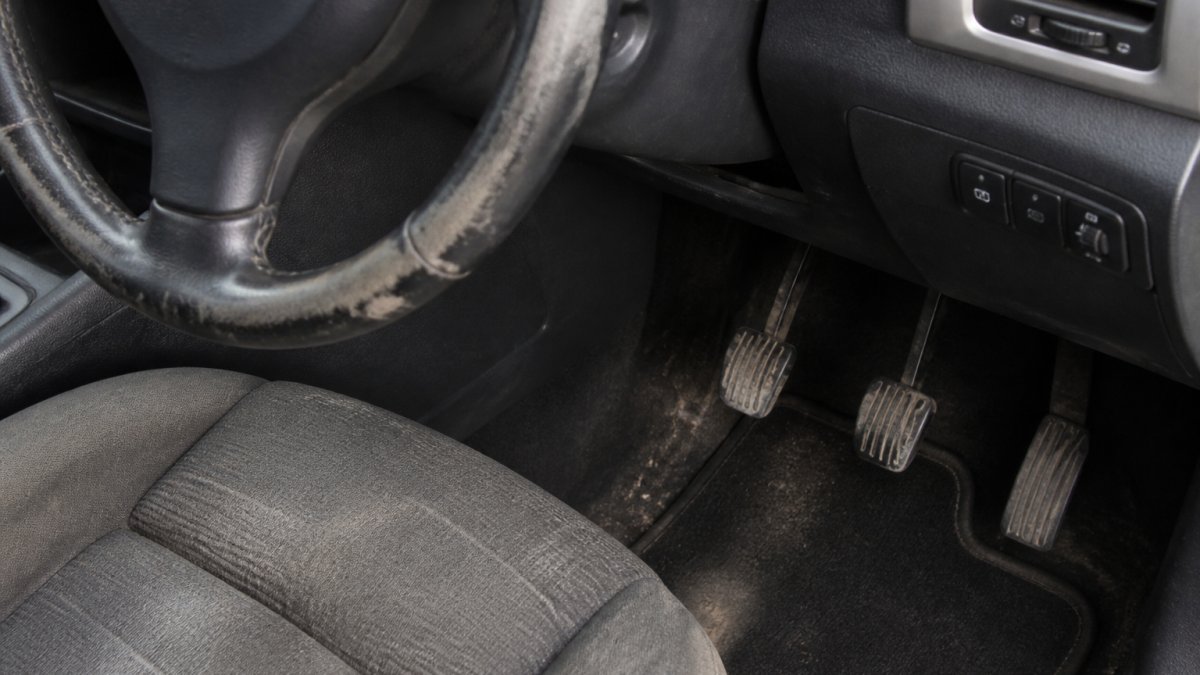
Steering wheel, pedals, and seat condition
Check the pedals next. The brake pedal takes the most punishment.
The accelerator pedal shows similar but less severe wear; a low-mileage vehicle should have relatively fresh pedals.
Inspect the driver’s seat thoroughly. High-mileage vehicles develop creasing and sagging in the seat base, fading fabric or leather, and cracked or peeling side bolsters.
Compare the driver’s seat to the passenger seat.
Dashboard and odometer display inspection
Examine the odometer display for signs of physical tampering. Modern digital odometers are harder to alter than mechanical ones, but check for loose or recently replaced instrument cluster panels, misaligned digits or flickering numbers, discoloration around the odometer, and scratches or tool marks on the dashboard trim.
Check overall dashboard condition. A vehicle with 40,000 claimed miles should have a pristine dashboard; if the wheel is worn, seats creased and door panels marked but the dashboard looks perfect, something doesn’t add up.
Step 3: Perform a Car Diagnostic Scan for Mileage Data
A diagnostic scan is the closest thing to reading a vehicle’s own memory, but it is not a universal truth machine. What it retrieves depends on make, model, model year and equipment level; assuming every vehicle stores the same data in the same place is the fastest way to a false conclusion.
Where mileage is actually stored
On most modern vehicles the odometer value is not held in one place. It is written to several electronic control units (ECUs) communicating over the vehicle’s networks (typically CAN bus, or K-line on older vehicles). Common locations include:
- Instrument cluster (often the master display value)
- Engine control module (ECM)
- Transmission control module (TCM)
On many vehicles these modules hold matching values and cross-check each other; on others only the cluster holds a usable value. That is why two identical-looking cars can behave completely differently under the same scan.
What a basic OBD-II scan can and cannot do
A generic OBD-II reader or basic app-based dongle is designed for emissions-related fault codes and live sensor data. It usually shows diagnostic trouble codes (DTCs), live data such as RPM, coolant temperature and fuel trims, and readiness monitors. It typically will not read stored odometer values from individual modules, compare mileage across ECUs, access manufacturer-specific or protected data blocks, or retrieve historical mileage logs.
What a deeper scan involves
A manufacturer-level or professional diagnostic platform (dealer-grade tools or capable aftermarket systems) can, on supported vehicles, read the odometer value stored in the cluster and other modules, compare those values, access service-interval and adaptation data that may reference mileage, and in some cases read event logs or coding histories hinting at recent module changes. Coverage is uneven: some manufacturers expose very little, others a great deal.
Do not assume a scan that shows matching values proves the mileage is genuine. A skilled rollback can be applied consistently across modules, and some tools rewrite multiple ECUs at once. Matching values reduce the likelihood of a careless tamper, they do not eliminate it.
A realistic scan procedure
- Identify the exact make, model, model year and engine variant, scan capability is tied to these, not the badge alone.
- Ask the technician which modules they can read on that platform, and which they cannot.
- Request a written report showing each module read, the value returned, and any module that could not be accessed.
- Compare the cluster value against every other readable value. Note discrepancies, but also note modules that returned nothing, absence of data is not evidence of tampering.
- Cross-reference the scan against MOT history and service records. The scan is one input, not the verdict.
A common pattern is a vehicle whose cluster reads low but whose service records and MOT history show a higher figure, far more telling than any single scan result.
If you are buying privately and the seller resists an independent scan, that resistance is itself information. A legitimate seller with nothing to hide has little reason to object to a technician reading the car’s own data.
Step 4: Identify Digital Odometer Rollback Signs
Spotting rollback is not about one dramatic clue but a pattern that cannot be explained innocently. Several legitimate events produce the same surface symptoms as fraud, so a sign on its own proves nothing, what matters is whether the explanation holds together.
Signs that warrant investigation
- An odometer reading that is implausibly low for the vehicle’s age and condition
- Service records or invoices showing a higher mileage than the current display
- MOT history showing a higher figure in a previous year than the car reads now
Each of these is a prompt to dig further, not a conclusion.
Legitimate causes that mimic rollback
Several ordinary events produce discrepancies that look like tampering:
Instrument cluster replacement. A failed cluster is often replaced with a second-hand unit that may carry the donor vehicle’s mileage, be corrected to match the car, or not be corrected at all. A mismatch between cluster and other modules can therefore be entirely innocent, provided there is a record of the replacement. Ask directly whether the cluster has ever been replaced, and look for an invoice.
Data-entry errors. A garage typing 85,000 instead of 58,000, or transposing digits on an MOT entry, creates a phantom discrepancy.
Genuine low mileage. Some cars really are barely used, a second car, a city runabout, a vehicle owned by someone who stopped driving.
Clock or module resets. Battery disconnection, module replacement or software updates can, on some vehicles, affect stored values or trip data.
How to tell the difference
The decisive question is whether the anomaly has a documented, plausible explanation that fits the rest of the evidence.
- If the cluster was replaced, is there an invoice, and does its mileage reconcile the figures?
- If a record shows an odd figure, do the records either side support it?
- If the unit is kilometres, does the conversion produce a consistent progression?
A rollback typically fails this test: the explanation is missing, vague, or contradicted by other records. A legitimate event usually leaves a paper trail, even if imperfect.
One discrepancy is a question. A pattern of discrepancies with no coherent explanation is a finding. Do not accuse anyone on the strength of a single odd record, and do not dismiss a pattern because each individual sign has an innocent possible cause.
Questions worth asking the seller
- Has the instrument cluster ever been replaced or repaired?
- Is the odometer reading in miles or kilometres?
- Can you provide the full service history, including independent garage work?
A straightforward seller answers these without hesitation. Evasion, contradiction or shifting explanations are more informative than any single number on a dashboard.
Step 5: Spot Mileage Discrepancies Between Records
Mileage discrepancies between documents reveal tampering attempts. Compare every available record for inconsistencies.
Create a spreadsheet with columns for date, source (MOT, service record, insurance document), recorded mileage and expected progression. Enter all mileage data chronologically. A legitimate vehicle shows steady progression; mileage that decreases or stays flat over months is impossible, since you cannot drive without the odometer advancing.
Watch for these patterns:
- Mileage that jumps dramatically between records
- Gaps in documentation that conveniently hide the true mileage progression
- Service records from a mechanic showing higher mileage than the current odometer
If an MOT certificate from two years ago shows 80,000 miles, and today’s odometer reads 75,000 miles, the odometer has been rolled back. This is definitive proof of tampering.
Request the vehicle’s complete MOT history from the DVLA, your most reliable source of historical mileage data and difficult to falsify.
Step 6: Gather and Document Your Evidence
If you suspect odometer tampering, gather comprehensive documentation before acting. Create an evidence file containing:
- Photographs of the odometer display and dashboard
- Copies of all service records and maintenance invoices
- MOT certificates showing historical mileage
Document the date and time of your inspection, include photographs with clear timestamps, and write detailed notes on what you observed and why you believe the mileage is inaccurate.
If you have a diagnostic scan performed, request a written report showing any discrepancies between the odometer reading and data stored in the vehicle’s computer systems, this carries significant weight if you need to report the issue.
Limitations of Digital Odometer Detection Methods
Understanding the limitations of detection methods sets realistic expectations. Not every vehicle stores comprehensive historical mileage data, older vehicles and some manufacturers retain minimal information.
Some diagnostic tools are more advanced than others.
MOT records are reliable, but they only show mileage at annual test intervals.
Some sophisticated odometer rollback methods leave minimal digital traces. High-end diagnostic equipment and professional-grade tools make tampering harder to detect. If you’re suspicious about a high-value vehicle, consider hiring a professional pre-purchase inspection service with advanced diagnostic capabilities.
Service records depend on the seller providing accurate documentation. If records are missing or incomplete, you cannot verify the full mileage history. Some owners don’t keep records, and some work is performed at independent garages that may no longer be in business.
Digital odometer traces are your best verification tool, but they work best alongside physical inspection, documented records, and professional diagnostic scanning.
Detecting digital odometer traces requires patience and attention to detail, but it protects you from a costly mistake. If you’re conducting dyno testing or diagnostic work on your own vehicles and need precise mileage control during stationary testing, Mileage Blocker‘s UK-made modules provide reliable, untraceable operation with plug-and-play installation and 24/7 expert support.
Frequently Asked Questions
Can a diagnostic scan detect odometer tampering?
Yes. A professional diagnostic scan accesses your vehicle’s electronic control module (ECM) and reads stored mileage data that digital odometer rollback devices cannot always alter completely. Certified scan tools can compare the odometer reading with mileage records stored in the vehicle’s computer system. However, sophisticated tampering may mask some traces, which is why a diagnostic scan should be combined with physical inspection and service record verification for the most reliable detection.
What are the main signs of digital odometer rollback?
Key digital odometer rollback signs include: misaligned or worn display digits on the instrument cluster, inconsistencies between the odometer reading and service records, wear patterns that don’t match the claimed mileage (e.g., pristine pedals on a 100,000-mile vehicle), and sudden drops in recorded mileage across maintenance invoices. Additionally, check for gaps in service history or repair records that should logically exist at higher mileages. Professional inspection often reveals these inconsistencies that casual observation misses.
How do I know if there’s a mileage discrepancy between records?
Compare mileage across all available documents: MOT certificates, service invoices, insurance records, and the current odometer reading. Calculate the expected mileage increase based on time intervals between records. If a vehicle shows 50,000 miles at one service and 45,000 miles six months later, that’s a clear mileage discrepancy. Cross-reference the seller’s stated mileage with title records and previous owner information. Document every discrepancy in writing with dates and sources for evidence.
What should I do if I suspect odometer tampering?
First, gather all evidence: service records, MOT history, diagnostic scan results, and photographs of wear patterns. Document the mileage discrepancy between records clearly. Contact a qualified mechanic or professional inspector for a formal pre-purchase inspection report. If you’ve already purchased the vehicle, report suspected fraud to the relevant authorities and consult a solicitor about your consumer rights. Keep all documentation organised and dated, as this evidence is essential for any claim or legal action.