
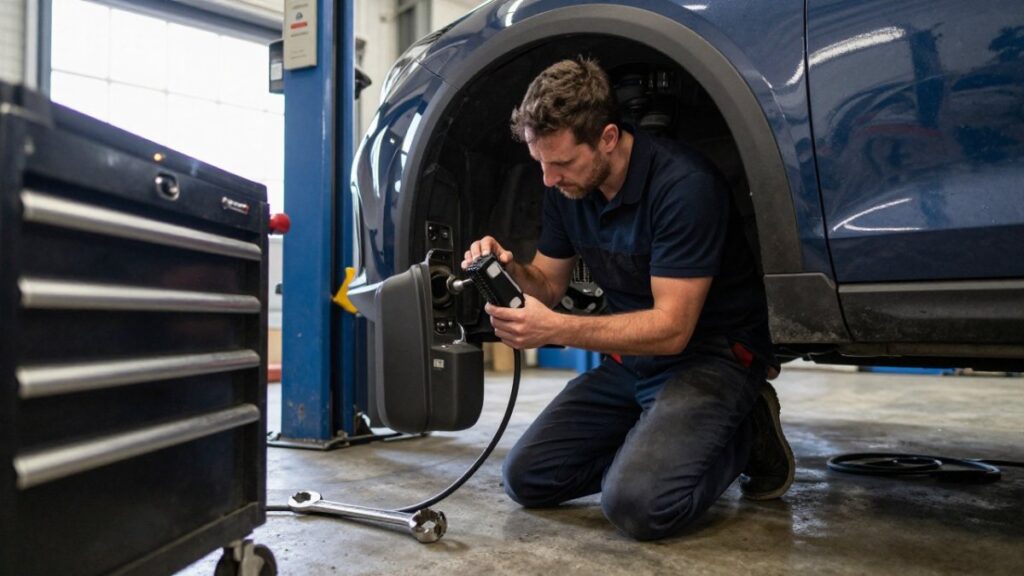
Reliable Odometer Blocker for ECU Tuning: A Buyer’s Guide
Quick Summary
An odometer blocker is a plug-in module that holds a vehicle’s recorded mileage steady while the car is stationary or under test, so ECU tuning runs do not change the mileage history. Reliability depends on checking compatibility for your make, model and year, confirming the reading after fitting, and removing the module once testing ends.
- Confirm compatibility against your exact make, model and year before ordering any module.
- Record the odometer from the cluster and any other distance-storing module before fitting.
- Check that the reading holds after reconnecting the battery, then clear any fault codes.
- Keep mileage recording active on vehicles under warranty or being sold with a logged service history.
- Remove the blocker after testing and document its fitting dates and readings.
Table of Contents
- What an Odometer Blocker Does During ECU Tuning
- Why Mileage Recording Should Stay Active on Some Vehicles
- Mileage Blocker for Dyno Testing: Where It Fits in the Workflow
- Mileage Blocker Compatibility by Vehicle
- Mileage Blocker Installation Guide: Plug-and-Play Steps
- Mileage Blocker Legality UK: Risks for Tuners and Owners
- Choosing a Reliable Module: Warranty, Support and Documentation
- Next Step: Booking a Compatibility Check Before You Buy
- Frequently Asked Questions
What an Odometer Blocker Does During ECU Tuning
An odometer blocker is a plug-in module that stops a vehicle’s recorded mileage from changing while the car is stationary or under test. For ECU tuners, it keeps the odometer steady while engine parameters are changed and measured, so the car’s mileage history is not affected by test runs.
Most modern vehicles log distance through the instrument cluster, which reads signals from sensors and the vehicle’s CAN bus. A typical module sits between that signal path and the cluster, so the displayed reading holds at its current value while the engine runs.
Be clear about what the module does not do. It does not change the vehicle’s service history, and it does not remove data already stored elsewhere. Mileage manipulation of any kind can lead to missed service intervals and inaccurate vehicle records, and those risks apply to tuning work carried out with a blocker fitted.
Why Mileage Recording Should Stay Active on Some Vehicles
Some vehicles need mileage recording left on during tuning. Service intervals, warranty claims and some diagnostic routines depend on accurate distance data, and a blocked reading can cause problems later.
Recording should stay active when a car is still under manufacturer warranty, when it is being prepared for a sale with a logged service history, or when a dealer or insurer will rely on the mileage later. In those cases, a blocker may create more trouble than the test saves.
Our practical advice is to decide before fitting anything. Check the warranty terms, the service schedule and what the owner will need on record. If the answer is unclear, leave recording active and use a different test method.
Mileage Blocker for Dyno Testing: Where It Fits in the Workflow
On a dynamometer, the car stays in one place while the engine is loaded, so a stable odometer reading is useful because repeated runs do not add distance to the vehicle’s record. The blocker should be treated as part of the test setup, not as a substitute for record-keeping, and the workflow below is the pattern most practitioners find reliable.
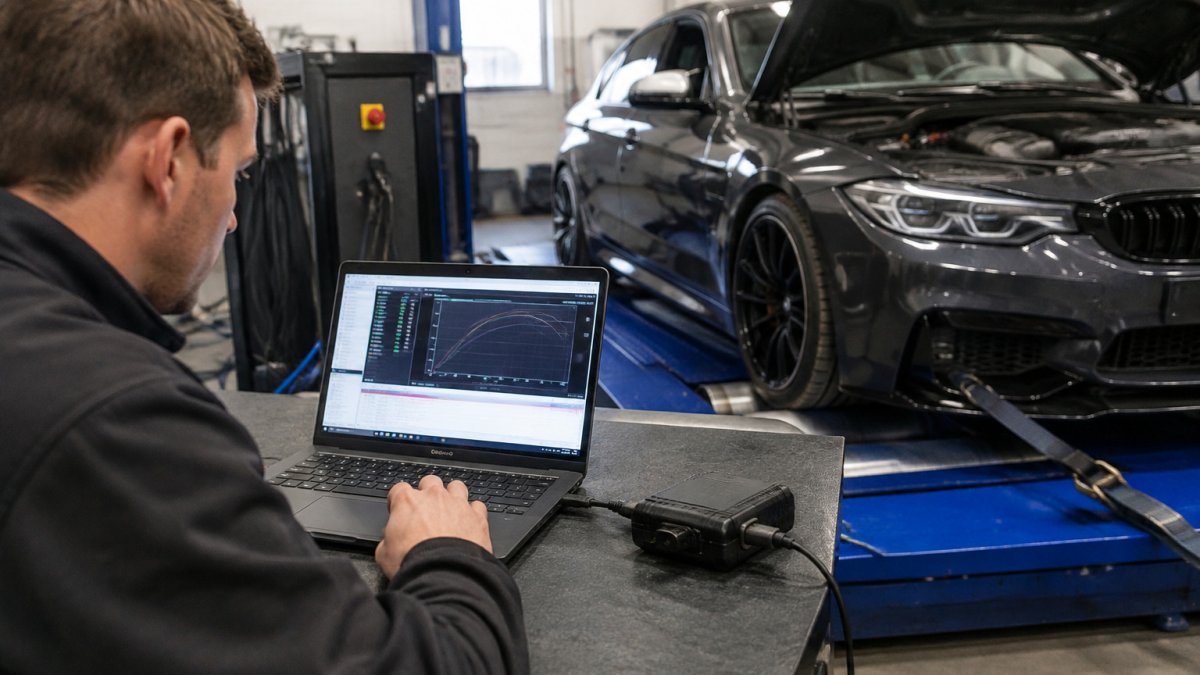
Before the first run, record the odometer value from the instrument cluster and, where accessible, from any secondary module that stores distance, such as the engine control unit or a gateway module. Fit the module in line with the fitting guide, reconnect the battery and confirm that the cluster reading holds while the engine runs. Then complete a short verification run on the dyno and re-check the reading.
During the session, keep the odometer check in the same routine as the other pre-run checks: tyre pressures, fluid levels, fault-code scan and the odometer reading. Log the starting value, the test sequence and the finishing value. A simple written or spreadsheet record is enough, but it should identify the vehicle, the date, the operator and the reason for the test.
After the session, remove the blocker, reconnect the harness as originally fitted, clear any fault codes and confirm that the odometer advances normally on a short road test where that is lawful and appropriate.
Watch out: a blocker that appears to work on the cluster can still leave a distance record in another module, so a single-module check is not proof that the vehicle’s mileage history is unchanged.
A technician working on a dynamometer usually has a laptop connected to the car, with tuning software open and recording engine parameters. Keep the odometer check in the same routine as those other checks, and note in the job sheet whether the blocker was fitted, for how long and at what recorded values.
The article sets out a short routine for recording odometer values before, during and after a dyno session.
| Stage | What to do | When |
|---|---|---|
| Before the first run | Record odometer from cluster and any other distance-storing module | Before fitting |
| After fitting | Reconnect battery and confirm the cluster reading holds | Before the first run |
| Verification run | Run on the dyno and re-check the reading | Before the tuning session |
| During the session | Log starting value, test sequence and finishing value | Each session |
| After the session | Remove blocker, clear fault codes, confirm normal odometer advance | When testing ends |
Mileage Blocker Compatibility by Vehicle
Compatibility depends on the make, model and model year, because each vehicle uses its own wiring and CAN bus layout. A module that suits one car may not suit another, even within the same brand.
Compatibility depends on the specific vehicle platform. Before ordering, confirm your car’s make, model and year against the product listing. If you are unsure, contact the team before you buy rather than fitting a module that does not match.
Owners of European performance cars should pay particular attention to the wiring harness. BMW owners can browse the reconditioned BMW Fxx chassis blocker to see whether it fits their platform. Some platforms use more than one cluster or gateway, which can affect how a module behaves. Check the fitting guide for your exact platform.
Mileage Blocker Installation Guide: Plug-and-Play Steps
Mileage Blocker modules are designed for plug-and-play fitting, with a fitting guide. The steps below give a general outline. Follow the guide for your specific vehicle. For the full walkthrough, read how to install an odometer blocker module safely.
- Disconnect the battery. Wait several minutes before working on the electrical system.
- Locate the instrument cluster and the connector. Remove trim as the guide describes.
- Connect the module inline. Plug it into the existing harness so the cluster receives the same signals.
- Reconnect the battery and check the reading. Confirm the odometer holds and no warning lights appear.
- Test the system. Start the engine and check for fault codes before the tuning session begins.
A common mistake is skipping the post-fit check. Confirm the reading and clear any codes before you start a session, not after. Keep notes of the installation date and the reading at fitting, so you have a record if questions come up later.
Mileage Blocker Legality UK: Risks for Tuners and Owners
Altering a vehicle’s odometer so that it shows a lower distance than the vehicle has actually covered can be a criminal offence in the United Kingdom (Mileage correction businesses: compliance review). Fitting a blocker for controlled test work is a different question in principle, but the line between test use and concealment can blur quickly, particularly if the vehicle is later sold, part-exchanged or returned to a fleet.
Misleading a buyer about a vehicle’s mileage can attract enforcement action, and the courts can treat a false mileage representation made for financial advantage as fraud. Check current guidance before relying on any specific legal position. For tuners, the practical risk is not only the act of fitting but the representation made afterwards: a car with a blocked odometer that is described as having its true mileage can expose both the tuner and the owner.
A responsible tuning workflow treats the blocker as test equipment, not as a permanent modification. That means fitting it only for the duration of the test, keeping the vehicle off the public road while it is fitted, recording the starting and finishing odometer values, and removing the module before the vehicle is returned or offered for sale. The record should identify the vehicle, the date, the reason for the test and the readings observed.
Watch out: a blocker left fitted after a tuning session, even unintentionally, can create a mileage discrepancy that is difficult to explain at resale and may amount to an offence if the vehicle is subsequently sold without disclosure.
Before relying on any interpretation, check the current position with the relevant official guidance and your local trading standards authority. Tuners should also consider their own professional indemnity and public liability cover, because a claim arising from a mileage dispute may depend on whether the blocker was used within a documented test procedure.
Risks to think about before fitting:
- Disclosure at sale: a car with a blocked odometer must be declared accurately, and a failure to do so can be a criminal offence.
- Warranty and insurance: blocked data can void cover or complicate claims, and some insurers treat undisclosed mileage discrepancies as material non-disclosure.
- Diagnostics: a blocker can cause fault codes if fitted incorrectly, and those codes may be stored in modules that are not cleared by a simple battery reset.
- Resale value: a mileage gap that cannot be explained with a test record will reduce the vehicle’s value and may deter trade buyers.
Alternatives worth considering for tuning and testing include controlled test procedures that keep the vehicle stationary, data logging of engine parameters without odometer intervention, and dedicated test equipment that records distance separately from the vehicle’s own cluster. Where a blocker is used, the decision should be documented and reviewed before the vehicle leaves the workshop.
Choosing a Reliable Module: Warranty, Support and Documentation
When comparing modules, look beyond price. Reliability depends on build quality, clear documentation and support that answers questions when something goes wrong.
Mileage Blocker offers a 12-month warranty on its UK-made modules, along with 24/7 support. Ask what the warranty covers, whether repairs or replacements are offered after the first year, and how fitting questions are handled. The odometer blocker warranty and repair guide explains each of these points.
Also review the fitting documentation. A detailed guide for your exact vehicle is worth more than a generic sheet, because mistakes at fitting are a common cause of faults.
Next Step: Booking a Compatibility Check Before You Buy
Before you order, confirm that the module suits your vehicle, your test plan and your legal position. Pricing depends on the module type, quantity and delivery, so check current prices and availability with Mileage Blocker directly.
Mileage Blocker can help you check compatibility and talk through the fitting steps for your car. Book a compatibility check for your vehicle before you buy, so the module you choose matches your platform and use case.
Frequently Asked Questions
What is an odometer blocker used for during ECU tuning?
An odometer blocker holds the displayed mileage steady while a vehicle is on a dyno or undergoing diagnostics, so the reading does not change during testing. Tuners use this to keep the vehicle’s recorded distance consistent across sessions. It does not alter engine data, but the blocker itself must be installed carefully so it does not interfere with the ECU or dashboard signals. Any use should follow current UK law, and where the mileage record matters to a buyer, service history or warranty, the reading should be documented accurately rather than concealed.
Are mileage blockers legal to use in the UK?
Using a device to change or hold a vehicle’s recorded mileage to mislead a buyer, insurer or the DVLA can be an offence under UK law. Legitimate use, such as stationary dyno testing or diagnostics on a vehicle you own, is a different matter, but you should keep records showing the purpose and never use the device on a vehicle you intend to sell without disclosing it. If in doubt, take advice from a solicitor or your local Trading Standards office.
Are mileage blockers compatible with every vehicle?
No. Compatibility depends on the make, model, model year and the CAN bus architecture of the vehicle, so a module that works on one car may not work on another. Before buying, check the supplier’s compatibility list against your exact vehicle and ECU, and ask whether the module supports your model year. Current pricing and availability are available directly from the Mileage Blocker website.
How do I choose a reliable mileage blocker for my vehicle?
Look for a module with documented compatibility for your vehicle, plug-and-play wiring with clear fitting guides, a stated warranty term and accessible technical support. Check whether the supplier explains how the device interacts with vehicle sensors and whether it leaves no fault codes or dashboard warnings during testing. Verify these claims against independent evidence where possible, because product pages describe their own performance. Mileage Blocker offers a 12-month warranty and 24/7 support.

Leave a Reply