

UK Made Odometer Module Comparison for Tuners
Last Updated: November 14, 2026
Quick Summary
A UK made odometer module should be judged on six criteria: build and housing, vehicle compatibility, configuration, warranty, support and provenance. Domestic manufacture mainly buys accountability, since a module assembled here sits within reach of the business that built it and that changes how faults get handled.
- Score every candidate out of the six comparison criteria before buying and keep the sheet with your workshop records.
- Our own module carries a 12-month warranty, plug-and-play fitting and 24/7 support.
- Mileage is written into several control modules, not just the instrument cluster, and those copies get compared during a diagnostic scan.
- Run four reliability checks first: connector quality, wiring gauge, protocol compatibility and ignition-cycle behaviour.
- Keep your own mileage records for every test session so the vehicle history stays honest and disclosable.
Table of Contents
- What UK Manufacture Actually Means for an Odometer Module
- Side-by-Side Comparison of UK-Made Odometer Modules
- How Mileage Data Is Stored Across Vehicle Control Modules
- Odometer Module Reliability Checks Before You Fit One
- Mileage Blocker Installation Guide for Dyno and Track Use
- Legal Use of Mileage Blockers UK: Where the Line Sits
- Choosing the Right Module for Your Workshop or Vehicle
- Frequently Asked Questions
What UK Manufacture Actually Means for an Odometer Module
An odometer module is an electronic unit that interrupts or adjusts the mileage signal travelling between a vehicle’s control modules and its instrument cluster. The phrase “UK made odometer module comparison” gets thrown around loosely, so let us be precise about what domestic manufacture actually buys you: accountability. A module assembled here sits within reach of the business that built it, and that changes how faults get handled.
The legal backdrop matters too. The Competition and Markets Authority guidance on mileage correction businesses is blunt that adjusting an odometer to show an inaccurate mileage can amount to a criminal offence under the Consumer Protection from Unfair Trading Regulations and the Fraud Act 2006. Any supplier selling into this space should know that paragraph by heart.
At Mileage Blocker, we build our modules here in the UK, and we say so plainly.
Provenance Signals to Check Before You Buy
- A named assembly location, not a vague “European quality” claim
- A warranty document tied to a registered business address
- Fitting guides written for specific make and model ranges
- A support line you can reach outside office hours
A product page alone proves nothing about reliability. Treat marketing copy as a starting point for questions, not an answer.
Side-by-Side Comparison of UK-Made Odometer Modules
Most pages that claim to compare odometer modules either list products without criteria or list criteria without products. A useful comparison does the opposite: it fixes the criteria first, then shows how domestic options stack up against each other and against imports on the same attributes. That is the approach here, and it is deliberately neutral, the aim is to give a workshop a repeatable way to judge any module, not to crown a single winner.
The Comparison Criteria That Actually Decide a Purchase
Six attributes separate a module that survives a season of dyno work from one that fails in the first month. Judge every candidate on all six, in this order.
| Criterion | What to Look For | Why It Matters |
|---|---|---|
| Build and housing | Sealed connector, strain relief at the loom, potted or conformally coated board | Vibration on a dyno destroys loose wiring and dry joints |
| Vehicle compatibility | Listed make and model coverage, including EV ranges and network generation | A generic module may not speak the right protocol |
| Configuration | Plug-and-play with documented pinout and fitting guide for the specific model | Reduces install time and error risk |
| Warranty | 12 months minimum, written terms, clear failure-mode cover | Covers early-life failures |
| Support | Reachable out of hours, named technical contact | Dyno sessions rarely run 9 to 5 |
| Provenance and documentation | Named assembly location, verifiable business address, fitting and compliance paperwork | Someone answerable for faults and a paper trail for the customer |
How Domestic and Imported Modules Differ on Paper
When comparing modules, the differences can show up in the connector, the documentation, the support you can reach and the warranty terms. Read what is excluded from a warranty, not just its length.
What ‘UK-Made’ Should Mean in a Comparison
Provenance is the criterion most buyers skip, and it is the one that decides who answers when something goes wrong. A credible UK-made claim should be specific enough to verify: a named assembly location, a registered business address on the warranty document, and fitting guides written for identifiable model ranges. Vague claims such as ‘European quality’ or ‘designed in the UK’ tell you nothing about where the unit was assembled or who is accountable for a fault.
When you compare, ask each supplier the same three questions: where is the unit assembled, what does the warranty document name as the responsible business, and can you reach a technical contact outside office hours. A supplier that answers all three plainly is giving you something a product page cannot.
Applying the Comparison to Your Own Shortlist
Score each candidate out of the six criteria before you buy, and keep the scoring sheet with your workshop records. Our own module carries a 12-month warranty, plug-and-play fitting and 24/7 support, but the point of the table is that you can hold any supplier, including us, to the same standard. Where a cheaper import looks identical on a listing, the difference usually surfaces at the connector, the documentation or the phone call after something goes wrong.
How Mileage Data Is Stored Across Vehicle Control Modules
Mileage is not kept in one place. A modern vehicle writes distance data into several control modules, and those copies are compared against each other during a diagnostic scan. That is the single most important fact for anyone fitting a blocker.
The instrument cluster holds the number the driver sees. The engine control unit, transmission module and, on many vehicles, the body control module and ABS unit keep their own records. A vehicle control unit coordinating the network may hold another copy.
Why the Instrument Cluster Is Only One Copy
Because the cluster is the display, not the archive. If a mileage discrepancy appears between the cluster and a control module, fault codes can be logged and a diagnostic scan will surface the mismatch.
Treat the vehicle network as a conversation. A blocker has to interrupt the right part of that conversation cleanly, without leaving the other modules talking to a silence they flag as a fault.
Odometer Module Reliability Checks Before You Fit One
Reliability comes down to four checks: connector quality, wiring gauge, protocol compatibility and how the module behaves when the ignition cycles. Run these before the unit goes anywhere near a customer’s vehicle.
- Inspect the connector pins for plating and fit
- Confirm the wiring gauge matches the vehicle’s loom
- Verify the module is listed for that exact make and model
- Test on a bench supply before fitting
- Check the warranty covers the failure mode you are worried about
A common mistake is buying on price and discovering the pinout differs from the listing. Our guide to 7 track day odometer module reliability checks that matter expands each of these into a full inspection routine.
Mileage Blocker Installation Guide for Dyno and Track Use
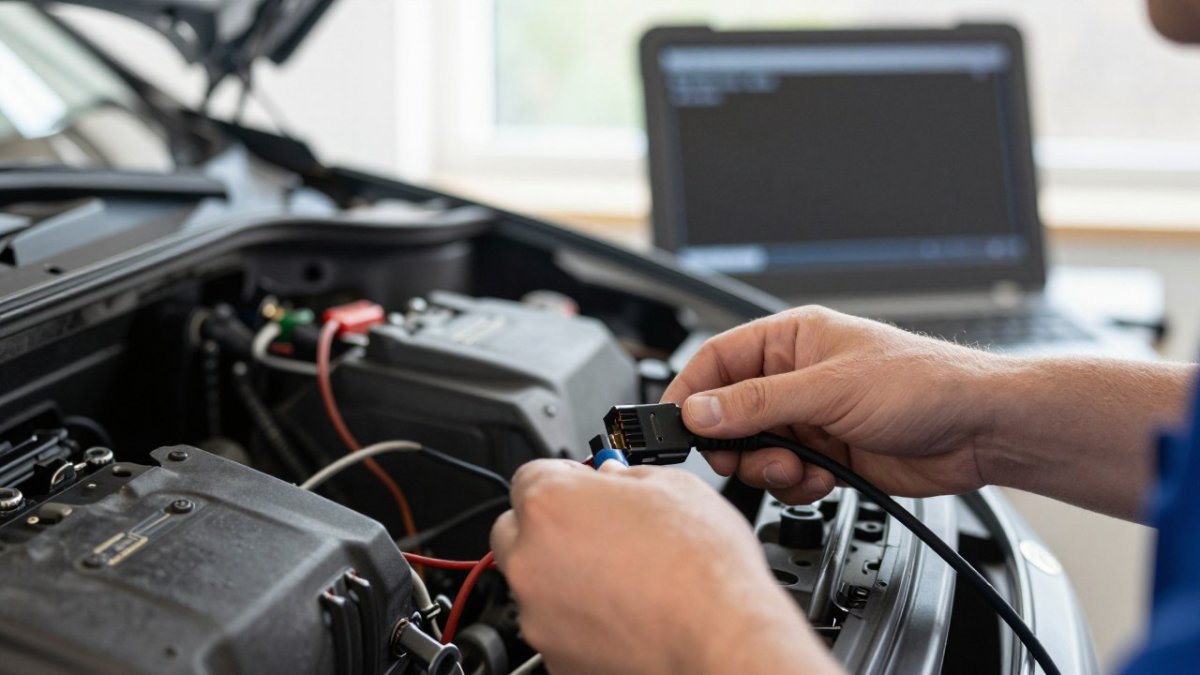
Work through it in order:
- Disconnect the battery negative terminal and wait for the network to sleep
- Remove the trim panel to reach the cluster connector
- Unplug the factory connector and seat the module inline
- Reconnect the battery and cycle the ignition
- Run a diagnostic scan to confirm no new fault codes
- Verify the cluster display and the stored mileage records before testing
Watch out: if the module is not fully seated, the cluster can show a blank display or log a communication fault, and that code stays in the vehicle history. Our step-by-step safe installation guide covers torque points and trim clips in more detail.
Legal Use of Mileage Blockers UK: Where the Line Sits
Using a blocker to prevent mileage accumulating during stationary dyno testing is a different act from presenting a vehicle for sale with a false mileage reading.
The Competition and Markets Authority compliance review of mileage correction businesses treats an inaccurate mileage representation as potentially criminal under the Consumer Protection from Unfair Trading Regulations and the Fraud Act 2006. The practical line for a workshop is disclosure: if the true mileage is recorded and the vehicle’s history stays honest, you are in a defensible position. If a blocker is used to mislead a buyer, you are not.
Two things follow. Keep your own mileage records for every test session. And read the deeper breakdown of 5 legal risks of using odometer blockers before you build this into a customer-facing service. For track and dyno specifically, whether mileage-free dyno testing is safe and legal is worth reading in full.
Choosing the Right Module for Your Workshop or Vehicle
Selection involves several decisions in sequence: vehicle fit, workload fit, evidence of reliability, and ownership consequences.
Step 1: Match the Module to the Vehicle, Not the Volume
Start with the vehicle. Confirm the exact make, model, year and network generation appear on the compatibility list, and check whether the module supports the protocol that vehicle uses. A small tuning shop running a handful of dyno sessions a month needs the same reliability as a large operation, just fewer units, so buy for compatibility rather than volume. For mixed petrol and electric fleets, buy the module that matches each vehicle rather than assuming one unit covers both; our EV mileage blocker range covers more than 70 models with plug-and-play fitting and a 12-month warranty, and the same model-by-model logic applies to combustion vehicles.
Step 2: Demand Evidence, Not Claims
Reliability claims are cheap. Ask for evidence you can check: a documented pinout, a fitting guide for the specific model, and a warranty document that names the responsible business. Where a supplier offers independent testing data, bench testing, network behaviour under ignition cycling, fault-code behaviour, treat that as stronger evidence than a marketing page. If no testing data exists, ask what happens when a module logs a communication fault on a customer vehicle; the answer tells you how the supplier handles the failure mode you are most likely to meet.
Step 3: Compare Installation, Warranty and After-Sales Support
Installation requirements vary more than listings admit. Plug-and-play with a documented pinout beats splicing every time, but confirm the module seats inline at the cluster or loom connection point without cutting factory wiring. Read the warranty terms in full: what is covered, what is excluded, and what the process is after year one. Check the support hours against your working pattern, a late dyno session needs a technical contact who answers, not a ticket queue.
Step 4: Understand the Resale and Record-Keeping Consequences
Before you build a blocker into a customer-facing service, decide how you will record every test session and how the vehicle’s history will be presented afterwards. Keep your own mileage records for each session, note the module fitment in the workshop file, and make sure the customer understands what the module does and does not change. If a vehicle is later sold, the true mileage and the test history should be disclosable; a blocker used to mislead a buyer is a different act entirely, as the Competition and Markets Authority compliance review of mileage correction businesses makes clear. The practical test is simple: if the records would satisfy a buyer and a regulator, you are in a defensible position.
Frequently Asked Questions
What are the benefits of using a UK-made odometer module?
Mileage Blocker modules are UK-made and come with a 12-month warranty and 24/7 support. When comparing modules, look for a stated warranty period and support you can actually reach.
How do mileage blockers differ from odometer correction tools?
A mileage blocker interrupts the signal path so the odometer stops recording while the module is active, then resumes normal counting when it is removed. Odometer correction tools write new values into stored mileage records, which changes the data permanently. Blockers used for stationary testing keep the original records intact; correction tools rewrite them.
Do plug-and-play odometer modules affect vehicle diagnostics?
Before fitting, check the module is matched to your make and model and that the supplier confirms compatibility. Mileage Blocker offers 24/7 support.
Are odometer modules legal for track day use in the UK?
Using a blocker to isolate mileage accrued during track days or stationary dyno testing is not itself the problem; misrepresenting a vehicle’s mileage is. Keep service records, dyno logs and track-day paperwork so the true vehicle history is documented. If you sell the vehicle, declare the blocked periods.

Leave a Reply